
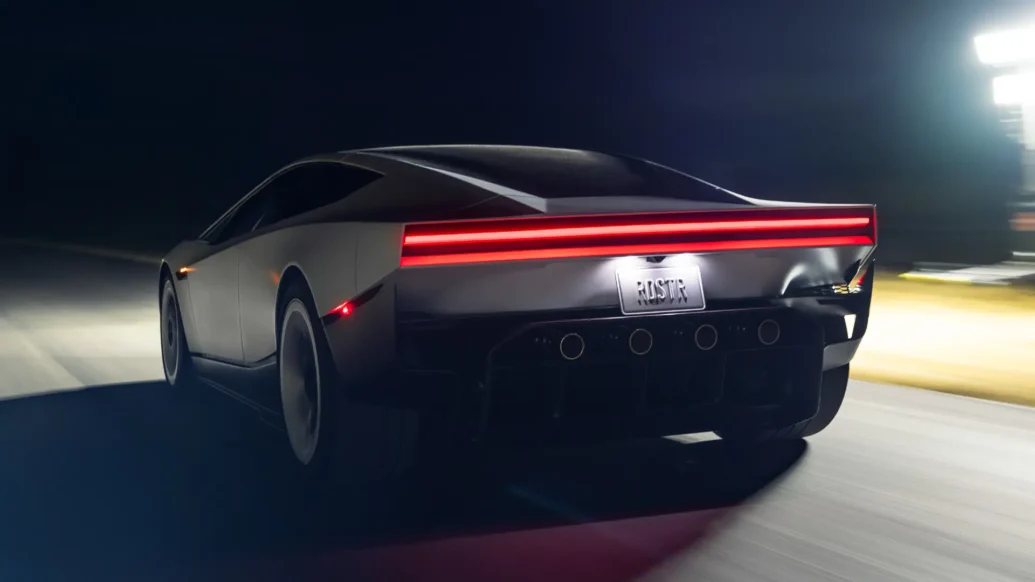
Tesla has revealed a new Roadster. It has thrusters. It can jump. It can flip through the air. Elon Musk would like it to reach half the speed of sound.
Our lack of enthusiasm might sound a little joyless. We’re normally enthusiastic about people building ridiculous cars, particularly when their engineers have been allowed to do something interesting. A sports car with enough fan-generated suction to hang upside down certainly qualifies.
But the Roadster has been coming for so long that another spectacular presentation mostly leaves us wondering when the next spectacular presentation will be.

We’ve been here before
Tesla unveiled its second-generation Roadster in November 2017, promising a car that would arrive in 2020. The performance claims were extraordinary: 0–60mph in under two seconds, a top speed beyond 250mph, and 620 miles of range on a single charge.
Nearly nine years later, we have another unveiling, another set of extraordinary claims and another production date. This time it’s 2028, just another two years away. Again.
If Tesla meets that target, it will have taken roughly eleven years to turn the original reveal into a production car. Eight years beyond the original arrival date. That is a lot of waiting for something whose entire personality is going very quickly.
At some point, keys need to be handed over to buyers.
Now with added rockets
The latest Roadster brings together active aerodynamics, a fan suction system and, depending on the version, cold-gas thrusters developed with SpaceX. Apparently, making an electric sports car now needs rockets.
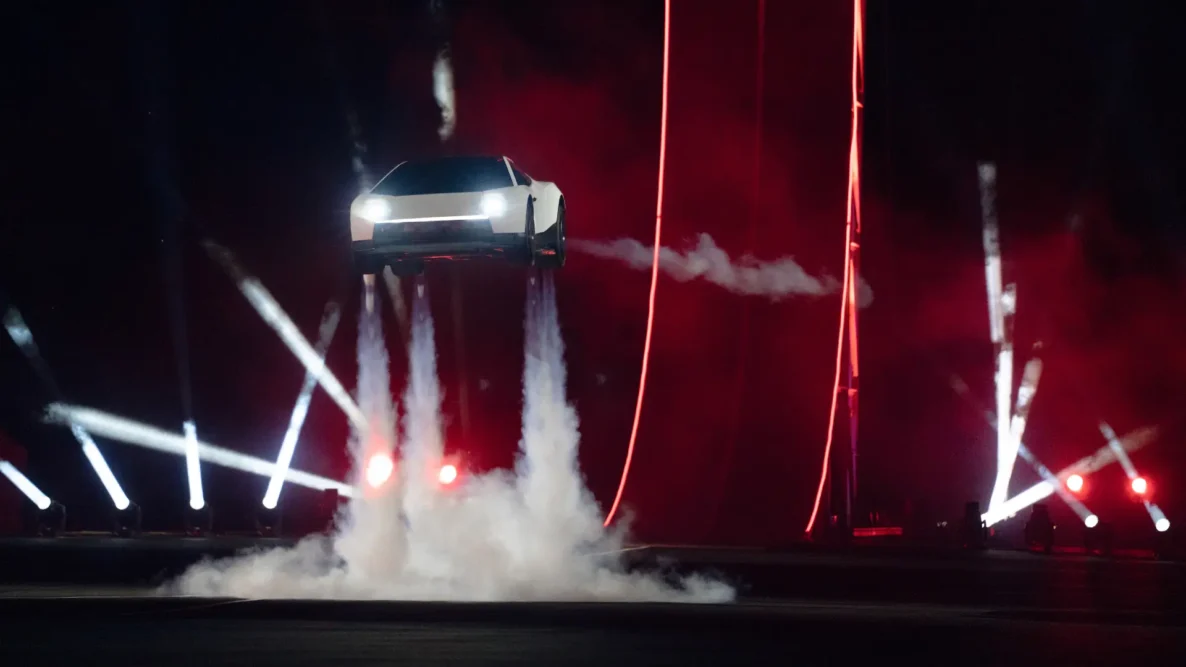
Those thrusters use compressed air rather than burning rocket fuel. During the presentation, Tesla described two pressure vessels with a combined capacity of 600 litres, holding around 250kg of air.
The demonstration included airborne manoeuvres and a displayed 0–60mph time of 0.81 seconds. Musk said the production car would do better.
This is seriously impressive engineering. Making a car stick to an inverted surface, launch into the air and control its attitude is a considerable technical undertaking, and the people responsible deserve credit.
But a staged demonstration doesn’t establish how a customer car will perform repeatedly, how long its pressure tanks take to recharge, or what happens when its clever systems encounter a less carefully stage-managed environment.
Those questions deserve answers before anyone starts treating the presentation as a finished specification.
Half the speed of sound. Eventually. Perhaps.
The speed discussion was particularly revealing.
Tesla quoted a top speed above 230mph — notably some way short of the 250mph claimed nine years ago. Musk promptly suggested going much faster: “You’ve got to crack halfway to the speed of sound, I think.”

That means around 380mph. It was followed by the challenge being accepted, rather than evidence of a car achieving it.
So, to be clear, Tesla hasn’t demonstrated a Mach 0.5 Roadster. Musk has suggested that one would be desirable. That is a rather important distinction.
There was also talk of attempting a Snake River Canyon jump, because apparently delivering the car is no longer a sufficiently ambitious obstacle.
Road legal? Well…
Tesla’s website separates the Roadster into three versions. Performance is described as “road ready”, with two seats, active aerodynamics and the suction system. Thrust adds rear thrusters and a claimed sub-one-second sprint to 60mph.
Rocket is the single-seat version, with thrusters around its perimeter that allow upward acceleration and rotation. It’s the one behind the flying-car excitement. The accompanying warning says it isn’t approved for public road use. And it’s unlikely it ever will be, at least in the UK.
Meanwhile, the website talks about going “beyond the limits of physics” and describes “extra-dimensional driving”. We’d settle for delivery within the usual four dimensions, ideally including a recognisable calendar year.
Give us a car, then
We want engineers to build ambitious things, we want sports cars to be exciting, and the world has room for gloriously pointless machinery. The Yangwang U9, the McMurtry Spéirling, or the Citroen C3 Pluriel all spring to mind.
But enthusiasm doesn’t require us to forget the previous promises every time Musk produces a bigger one. The Roadster’s problem is that Tesla is asking for another round of excitement before delivering the car that generated the first round. Or the second round. And so on.
If a production Roadster arrives in 2028 and does what Tesla says it will, we’ll judge it on that achievement.
Until then, the most impressive trick it could perform would be arriving on time.

He is the founder of Huff Media, publisher of Professional Pickup, Professional Van, Average Janes, Average Joes, and CALIBRE. His work focuses primarily on light commercial vehicles, pickups, and real-world vehicle use, with much of his time spent on manufacturer launches, industry events, and long-term vehicle testing.