

You need to look quite carefully to spot that this is an updated Polestar 2. The grille has been blanked off (a little unsuccessfully, given the sizeable square cutout for the radar system), and there are some new wheels to choose from, but what was already a good-looking car has been left mostly alone — and it’s all the better for that.
There’s not much change inside, either; the same 11.2-inch infotainment display remains, but it looks and feels vastly different to the system we tested previously. That’s because there have been 15 updates to the software, which every owner benefits from thanks to free over-the-air updates. It keeps the car feeling fresh and lets existing owners benefit from the latest technology, so it clearly falls into the ‘good thing’ category.

What’s changed?
Seemingly, everything under the skin has changed. There’s a new battery pack, a new electric motor, and a change from front to rear-wheel drive for the Long Range versions. It’s more powerful and faster, promises to be more fun to drive, and, somehow, more efficient.
Range has increased by 22%, which means the Polestar 2 Long Range Single Motor model we have here can run for up to 406 miles on a single charge of its new 82kWh battery pack. Real-world results will vary depending on your driving style, weather, road conditions, and so on, but even on a bad day, that’s a good chunk of miles you’ll be able to cover before needing to stop and charge.


How far? On a rather enthusiastically driven route around the Cotswolds, the onboard computer said we’d drained a kWh of electricity every 3.6 miles, which translates to a range of 295 miles. You’ll be able to do much better, but don’t think you’ll do 400 miles on the motorway without stopping.
When you do, the Polestar 2 can take electrons at up to 205kW, which should see a 10-80% top-up sorted in around 28 minutes — just about enough time to pop into some services, use the facilities, grab a takeaway Costa, and get back on the road for another few hours.
Is it better to drive?
The Polestar 2 was never bad to drive, but the stiff chassis and suspension could make it a tough ride on UK roads. Still, that hasn’t put off the 17,000 buyers here, so Polestar has kept it much the same, meaning there’s plenty of grip and traction. There’s just not much fun to be had despite the switch to rear wheel drive.
It’s quite a digital experience, with the driver making inputs through the pedals and wheel and the car carrying out the instructions in an unflustered and confidence-inspiring way. However, you have to push incredibly hard to unlock any of the rear bias the car now has. It’s hard enough that, frankly, it’s unlikely anybody not robbing a bank will find the limits where those glimpses of entertainment shine through.
However, don’t read that as a negative. Modern cars are supremely capable, and you’ll likely need to be travelling far quicker than you’ll be comfortable with — easy to do with 299hp under the bonnet (well, boot floor, as the electric motor is at the back) — before you find the limits.

Instead, the 2 is as solid and stable as you could imagine, following a line around any corner precisely as you intended. There’s little body roll, light and direct steering, and computers that don’t interfere unless necessary. It’ll be a perfect companion if you’ve got a long journey ahead.
Apart from the fact that it’s still quite stiffly sprung. The ride quality isn’t too bad on a smooth A-road, but it struggles to cope with heavily broken surfaces, clunking its way through the worst of the UK’s roads. Our car had the optional 20-inch wheels, which might be unforgiving with the slim tyre sidewalls, but we’re not sure the 19-inch option will be significantly better.

Any updates inside?
Not that you’d notice initially, as everything is physically much the same. If you imagine a Volvo with some smarter materials and a more cohesive digital interface, you won’t be too far off from reality.
The dominant screen in the centre of the dashboard hosts the latest version of Google’s Android Automotive operating system, which is brilliant in many ways but has a fatal flaw for some users.
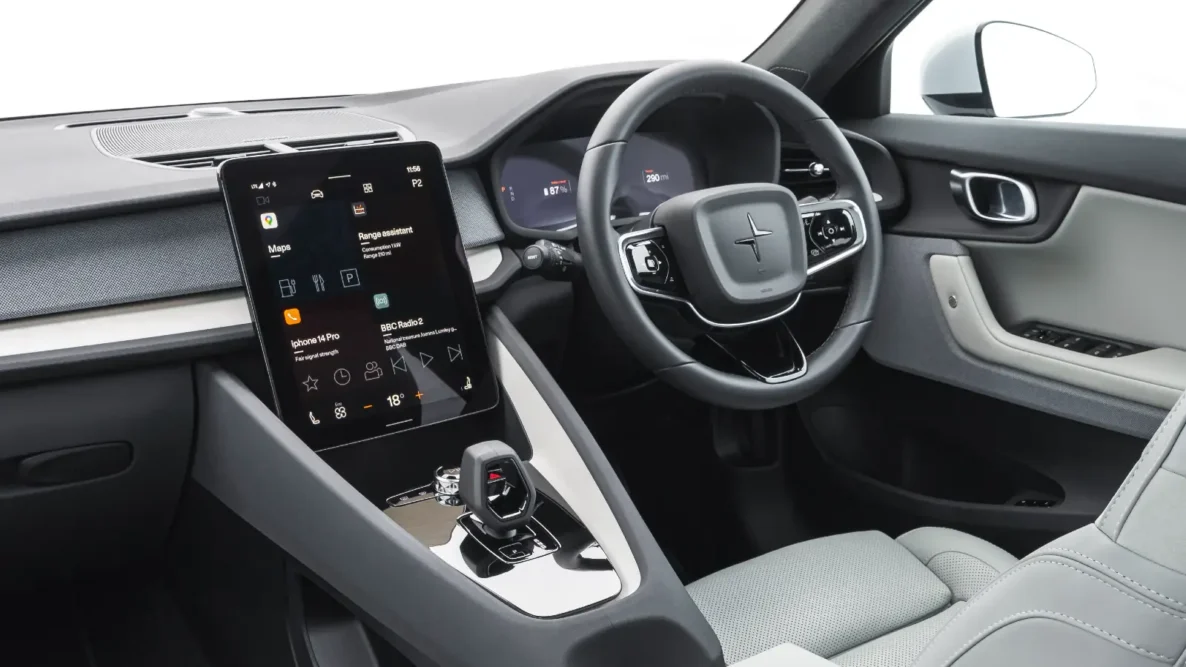
Most things you’ll need are on the front screen and are quickly accessible even when driving. Google Maps and other Google services are built in, although you can run Apple CarPlay if that’s your bag.
Google Assistant is also in place, so you can talk naturally to the screen and (mostly) get helpful responses. Want to navigate home? Just call out, “Hey, Google, navigate home,” and the car will do the rest.
Log in with your Google account, and you’ll have access to your contacts, calendar, music streaming, and more. The flaw? If you want to log in using a Google Workspace account — the subscription service Google offers to corporate users — you’ll find yourself locked out and unable to access your data. For a car likely to be taken on as a tax-efficient company vehicle, that seems like a huge oversight, although it’s an oversight by Google, not Polestar.


Elsewhere, it’s all exactly the same as it’s always been. There’s plenty of space in the font, with a slightly higher driving position than a regular hatchback. In the back, it’s less generous but acceptable, and the boot is usefully capacious at 402 litres, with the hatchback offering easy access.
Should I buy a Polestar 2 Long Range Single Motor?
We’d be keen to test out the cheaper Standard Range model, with its 331-mile range. This gives away 27hp to the Long Range model and has a 69kWh battery pack instead of 82kWh, but it’s a little lighter, a little more efficient, and considerably cheaper. It could be the sweet spot in the Polestar 2 range.
Every model in the range gets the same reasonably comprehensive list of equipment as standard. You can then add some packs that include adaptive cruise control, matrix LED headlights, a panoramic sunroof, and a Harmon Kardon sound system.

Which means the choice of which to buy comes down to your needs. Range, performance and cost can all be balanced, but should you? We like the Polestar 2 and always have done. It’s not perfect, and the ride quality could frustrate those living in remote areas away from smooth motorways, but it’s a pleasing, elegant, efficient and practical EV that still looks good four years after its launch.
Who needs a facelift anyway?
Model Tested: Polestar 2 Long Range Single Motor
Average Joes Rating: ★★★★☆

He is the founder of Huff Media, publisher of Professional Pickup, Professional Van, Average Janes, Average Joes, and CALIBRE. His work focuses primarily on light commercial vehicles, pickups, and real-world vehicle use, with much of his time spent on manufacturer launches, industry events, and long-term vehicle testing.
- There’s a new Tesla Roadster with rockets. We’re struggling to care. - 16 October 2026
- Paris Motor Show 2026: Small cars, big ideas and names you’ll be hearing more of - 16 October 2026
- DeLorean joins flying car racing because roads are apparently optional - 14 October 2026