

In a landscape filled with compact SUVs, ranging from the popular Ford Puma and Nissan Juke to the distinctive Toyota Yaris Cross and Vauxhall Mokka, the Peugeot 2008 has always stood out. This isn’t necessarily because it’s superior to its competitors — it’s undoubtedly competitive — but it exudes a unique sense of style. The current generation model, which arrived in 2020, brought it bang up to date, and all that was true about the regular model applies equally to the electrically-powered E-2008.
The whole 2008 range has had a nip and tuck to keep it feeling fresh — there’s a new grille, LED lights front and rear, new wheels, and a shiny new Peugeot badge — but the E-2008 has had a more fundamental change: It now boasts an upgraded battery pack and a more powerful, more efficient motor to keep up with its rapidly improving rivals. At its launch, electric alternatives were sparse, but today, it faces competition from a new generation of EV models like the Renault Megane E-tech, Kia Niro EV, BYD Atto 3, and its Stellantis sibling, the Vauxhall Mokka Electric.
The E-2008 shares many features with the latter, including the chassis, and now takes on the larger 54kWh battery pack (a modest increase from 50kWh) and a more powerful 156hp motor (up from 136hp). All the power is directed to the front wheels — despite its SUV pretensions, there are no all-wheel-drive or rugged off-road options. It’s almost the definition of safe family transport.

Given that, the performance from the Peugeot E-2008 is perfect for the job at hand. It’s quick enough, sprinting to 62mph in 9.1 seconds, and it always feels like there’s at least some power in reserve. Around urban areas, the instant torque makes it a cinch to drive, with light controls and decent responses from the car. There are three driving modes to help, with a recalcitrant ‘Eco’ mode best avoided and a ‘Sports’ mode that’s a bit too sharp to relax with. ‘Normal’ will do the trick in almost all circumstances.
Country roads can be tackled without concern, with the capable suspension soaking up bumps and cracks in the road nicely. The suspension controls the car well, even though there’s quite a lot of body roll, but it’s a well-balanced, neutral car that inspires confidence, if not excitement. Motorways are a breeze, with little road noise and even less wind noise, even if they run the range down rather more quickly.
Range is always a concern for those considering an electric car. Somehow, Peugeot has worked wonders on efficiency, and despite having just 8% more capacity than the previous model, the available range has improved by more than 15% — the official WLTP-calibrated range rises from 214 miles to 250 miles. Our time in the car resulted in a range of 180 miles, but that included some rather more enthusiastic driving than might be expected, as well as mountains and motorways.
Recharging is quick enough, with 30 minutes on a typical 100kW public charger enough to add 60% of charge to the battery, sufficient for another 151 miles of range.
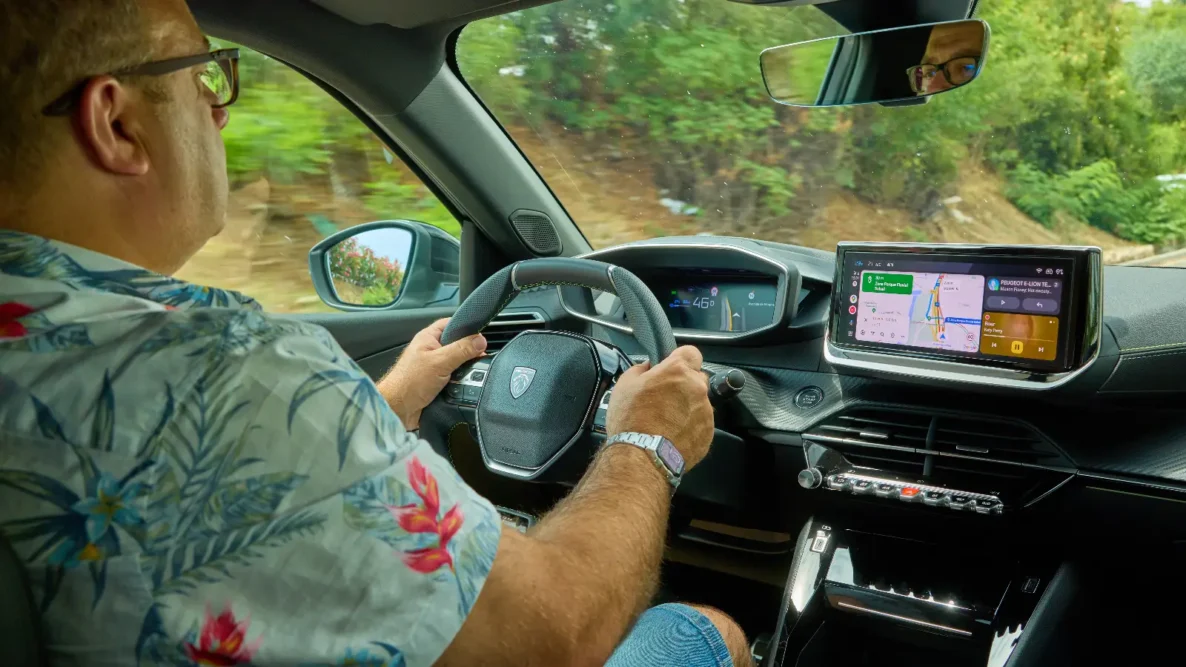
Inside, an updated version of Peugeot’s i-Cockpit installation is in place. That early 2000s tech-bro name tag is just another word for a small steering wheel with an instrument panel that sits above the rim. This writer likes the distinctive setup, finding a driving position that works in every model so far, bar the 308. If it’s your first time, you’ll be spending a lot of time adjusting the seat and steering wheel to find the right setup, but you will eventually get there, and then you’ll revel in the feeling of space the system provides.
The instrument panel is fully digital, with a new design for this update. It’s mostly clear, but sometimes you’d like to forgo the flash graphics and just have some traditional dials. Yes, you can switch it to a ‘dials’ mode, but it’s not the same.
Alongside is a 10.0-inch infotainment screen, with high-definition graphics on high-specification models. It’s got everything you’d expect, from a DAB radio to wireless Android Auto and Apple CarPlay smartphone connectivity. The GT specification car we were driving also includes wireless phone charging — handy, as navigation isn’t included with the infotainment system, so you’ll be relying on your phone. The rest of the dashboard is stylish and usable, with piano switches for frequently used controls and a prominent knob to adjust the sound system’s volume. If you don’t want to touch anything, you can bark “OK Peugeot” at the car and ask it to perform various tasks with varying degrees of success.
The seats are comfortable, if a bit narrow, with plenty of room up front for all drivers. Unlike many other SUVs, you don’t sit very high, so there’s no commanding view of the road, but the flip side is plenty of headroom. The same is true in the back, where you’ll have enough space, but a high window line and dark trim make it feel claustrophobic. There are plenty of cubby holes and pockets around the cabin, so family detritus should be kept in check. The boot is decent and sensibly shaped, with 434 litres of space to carry luggage for a family holiday.
It is in serving as everyday family transport that the Peugeot E-2008 truly shines. The updated model, with its enhanced efficiency, elevated specifications, and sharper styling, makes it even more attractive.
Model Tested: Peugeot E-2008 GT
Average Joes Rating: ★★★★☆
| Price : | £40,550 | Range : | £36,340–£41,600 |
| Power : | 156 hp | Torque : | 260 Nm |
| Max speed : | 93 mph | 0-62mph : | 9.1 secs |
| Range : | 250 miles | Recharge : | 130 kW |
| Car tax : | £0 | BIK : | 2% |

He is the founder of Huff Media, publisher of Professional Pickup, Professional Van, Average Janes, Average Joes, and CALIBRE. His work focuses primarily on light commercial vehicles, pickups, and real-world vehicle use, with much of his time spent on manufacturer launches, industry events, and long-term vehicle testing.