
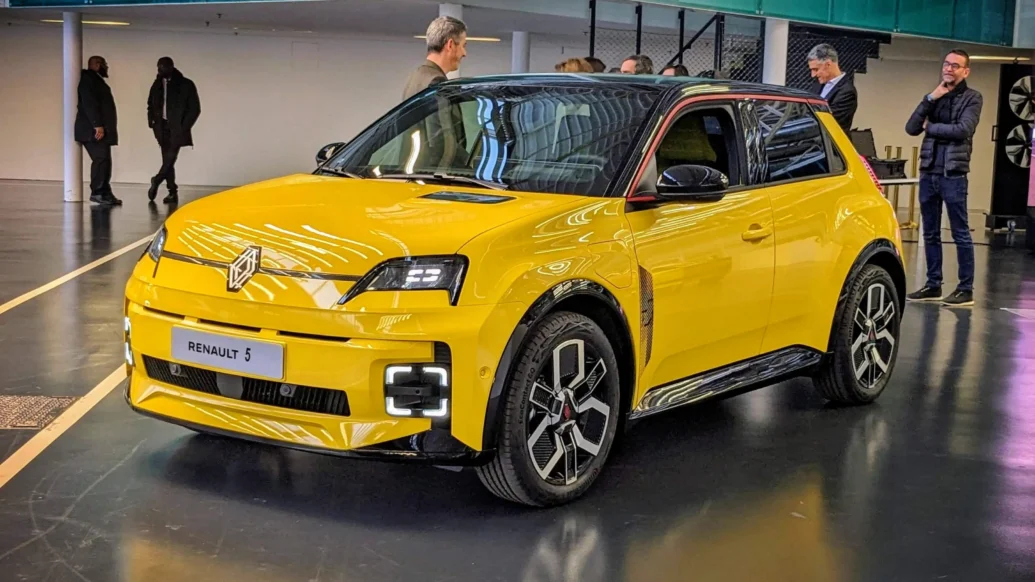
The Renault Voiturette 1CV was the first car that Louis Renault sold, way back in 1898, and he built his car company from there. It’s since democratised the automotive world many times, bringing motoring to the reach of the masses successfully, time and time again, with everything from the first hatchback —1961’s Renault 4 — to arguably the first family MPV, the famous Renault Espace of 1984. Between those two, it created the Renault 5, and while it didn’t start the compact hatchback market, it gave it one heck of a kick up the ass.
Since then? Well, there’s not been anything quite so iconic. Innovative, certainly, and undoubtedly successful — the Clio, the car that replaced the 5, is still going strong after 34 years — but nothing to stir the soul in the same way.
Car designers design cars, and can’t stop doing it. Even if there’s no commercial value, they’re sketching away, pushing boundaries, stretching credibility and reinventing what’s gone before. It was an early design of this pure-electric Renault 5 that caught the eye of the firm’s new boss, Luca de Meo. The CEO looked at it and declared that it had to be built.
He’s got form, having been responsible for reintroducing the 500 when he was at Fiat. The 5 is expected to have the same impact, reinvigorating the brand. “I know from experience that reinventing a cult product lights a fire under the whole brand,” said de Meo when the Renault 5 Concept was revealed in 2021. “This is a cult vehicle at a price many can afford. And this is only the beginning for the whole Renault brand.”

The concept went down well, but production cars rarely follow the evocative forms that shape our expectations. Average Joes got the opportunity to spend some time with the production-ready prototype and, walking around the car at Renault’s Technocentre near Versailles, it’s evident that’s not the case here.
A 1972 model shows where it all started, and while the new Renault 5 unashamedly borrows design cues from the original, the new car is a modern model.
There are constants that a 5 must have, regardless of when it was produced. The front lights and the crease along the front wing are hallmarks, with the square lights of the original replicated by the LED daytime running lights mounted lower on the new car. The front wing is bolder, broader and more masculine but without appearing too brawny. The vent behind the front wheels has gone from the concept, replaced by a sticker that adds some definition but perhaps isn’t as cohesive as the rest of the car.
At the back, the roof rim of the old model appears but runs around the back into an aerodynamic spoiler — essential when you’re using every trick to reduce drag and improve efficiency.

The crisp tower of lights at the rear of the old 5 is replicated here, with some clever wind tunnel work creating a shape that harks back to the original but, again, is designed to be aerodynamically efficient. It’s a neat trick — rather than creating a unique reflector and putting that behind flat (or curved) plastic, the designers have created an incredibly complex light cover encompassing horizontal strakes, darkened areas and three-dimensional contours that separate the airflow at the back of the car.
“There’s a theory that you can do everything with calculations and simulations,” explains Gilles Vidal, vice president of design at Renault, “but when you’re going to a wind tunnel, you try things, even in clay, and find solutions that are super counterintuitive but actually work.”
A highlight of the concept is the panel on the bonnet, harking back to the air intake of the 1972 model. This was where the charging port was going to be, but cost control and practicality have ensured it’s now in an utterly conventional position ahead of the left door. Renault is still making use of the space, including an entirely unnecessary but interesting digital panel showing the car’s charging status.
It’s one of the few areas where the finished article differs from the concept, but you wouldn’t spot it at first glance. The daytime running lights are the same shape, but now divided into quarters, and the 19-inch wheels have shrunk slightly to 18 inches with 618mm diameter tyres that fill the wheel arches well while promising a more cosseting ride.

Most apparent is the loss of the massive lit-up RENAULT logo on the front and back of the car. To these eyes, the front is neater and more in keeping with the rest of the vehicle. The back is less successful, where the black panel with bright RENAULT logo has been replaced by a somewhat messy collection of lines, shades and, obviously, a number plate. Perhaps paint that panel black again for the mid-life facelift?
Inside, it’s got more 1970s touches without feeling in any way retro. The dashboard trim has vertical bars running through it — a nod to the feature accidentally introduced on the original 5 prototype — while material choices range from denim to velvet. The seats themselves are reminiscent of the heavily sculpted seats in the bonkers GT Turbo, and the steering column-mounted drive selector links to days gone by, but with some colourful options to make an otherwise functional piece of equipment stand out. You can have the selector coloured with a French tricolore, a 1972 graphic or, if you want to cringe a little, some text that reads ‘WT5’. There’s even an optional baguette holder, because France.

Sustainability is important, with many of the surfaces clad in 100% recycled material and others having a high recycled content. It all feels and looks good, although the link to the classic model falls away when you see the twin digital screens that make up much of the dashboard.
This is one area that’s not ready yet, but the displays are tilted towards the driver, creating an encompassing cockpit, and the user interface looks great, with anything that can be angled, angled by 28° — that’s the angle of the Renault diamond.
“Let’s just have a little tilt, right?” adds Vidal. “Ultimately, cars of this size, 99% of the time, there’s one person on board. We have to acknowledge that, so we said, okay, let’s just give it a little bit of orientation to the driver, without going super hardcore sports.”
What is less convincing is the threat promise of a digital assistant called Reno, a cartoon diamond with floating hands that looks like a cross between Microsoft’s infamous Clippy and PlayStation’s Rayman. In an otherwise sophisticated and stylish cabin, it’s a sloppy and childish device, no matter how well it works.
You can switch Reno off and then choose between one of 244 different styles for the infotainment system, which includes sounds designed by Jean Michel-Jarre. Once you’ve passed all that, you’ll find that Google is built into the system to give an impressive amount of connectivity.

The tech is nice to have, but it’s style that will sell the Renault 5, and Vidal thinks there’ll be plenty of opportunities to boost the car’s appeal by partnering with other designer brands, like the Fiat 500 by Gucci.
“We might have a plan like that,” Vidal says with a smile. “It has huge potential. Since the Renault 5 became known, brands have come to us, which is an incredible sign. If we had a Renault Captur, nobody would come to us; it’s a nice car, a good car, it sells well, but it’s not an iconic car. When you start to make iconic things like this, connected to history… we’re a mainstream brand in terms of price, but we want to trigger something special.”
There undoubtedly is a plan for something special. While poking around some parts, we spotted a Chanel logo on a gear selector stalk, so it looks like it won’t be long before Renault starts rolling out special editions.

Sales will be helped by the fact that it’ll be an affordable electric car — Renault insists it’ll start at less than €25,000, which is about £22,000 assuming a straight conversion — with a range of more than 180 miles. It’s compact, so space is tight in places, especially in the back, but any car measuring less than four metres will never be overwhelmed with space.
And there’s still time for a little fiddling. Testing for noise and vibrations on real roads has yet to be completed, and there could be some minor changes to the aerodynamics to remove errant wind noise or improve efficiency a little.
But, by and large, what we’ve seen here, and what’s on display at the Geneva Motor Show, is the finished product. And we can’t wait.

He is the founder of Huff Media, publisher of Professional Pickup, Professional Van, Average Janes, Average Joes, and CALIBRE. His work focuses primarily on light commercial vehicles, pickups, and real-world vehicle use, with much of his time spent on manufacturer launches, industry events, and long-term vehicle testing.
- The Midnight made a Bluetooth cassette player, and I need it - 30 September 2026
- First drive: Toyota Yaris Cross review – new face, familiar strengths - 25 September 2026
- GKU E200 review: A brilliant £100 dashcam with one rather awkward problem - 28 August 2026