

There are certain products on Amazon that immediately trigger the scepticism gland. The GKU E200 dashcam is one of them.
Here is a dashcam from a brand you’ve probably never heard of, promising front and rear high-resolution recording, Sony STARVIS 2 technology, GPS, voice control, parking surveillance and even a memory card in the box.
And you can buy the lot for around £100 when one of GKU’s seemingly permanent-looking discount vouchers is applied. Right now, it’s £94.99 if you remember to tick a box.
So, naturally, we expected it to be a bit rubbish.
Spoiler: It isn’t.
What’s Hot:
Excellent value
Surprisingly good footage
GPS and voice controls genuinely useful
Memory card included
What’s Not:
– Primitive app
– Worrying privacy policy
– More limited camera adjustment than some rivals
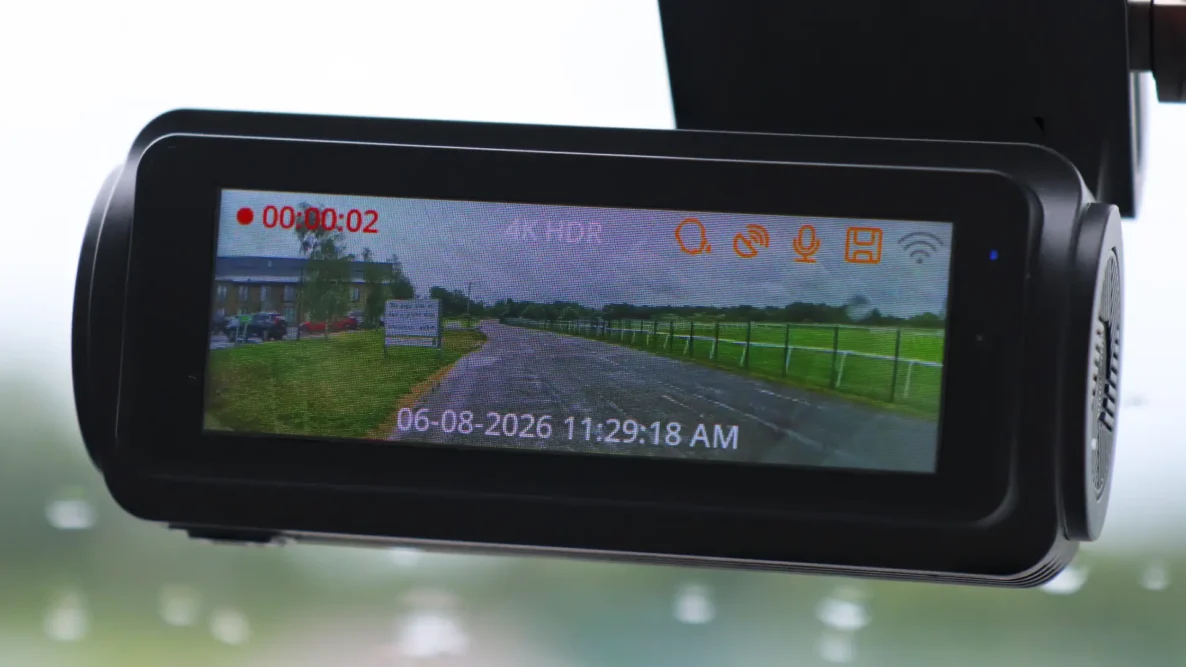
In fact, the GKU E200 is an annoyingly good little dashcam. The video is impressive, installation is simple, the useful features actually work and there’s very little about the camera itself that gives away its bargain-basement price.
But there is a caveat. We read the privacy policy.
What is the GKU E200 dashcam?
The E200 is a two-channel dashcam, with one camera covering the road ahead and another looking through the rear window.
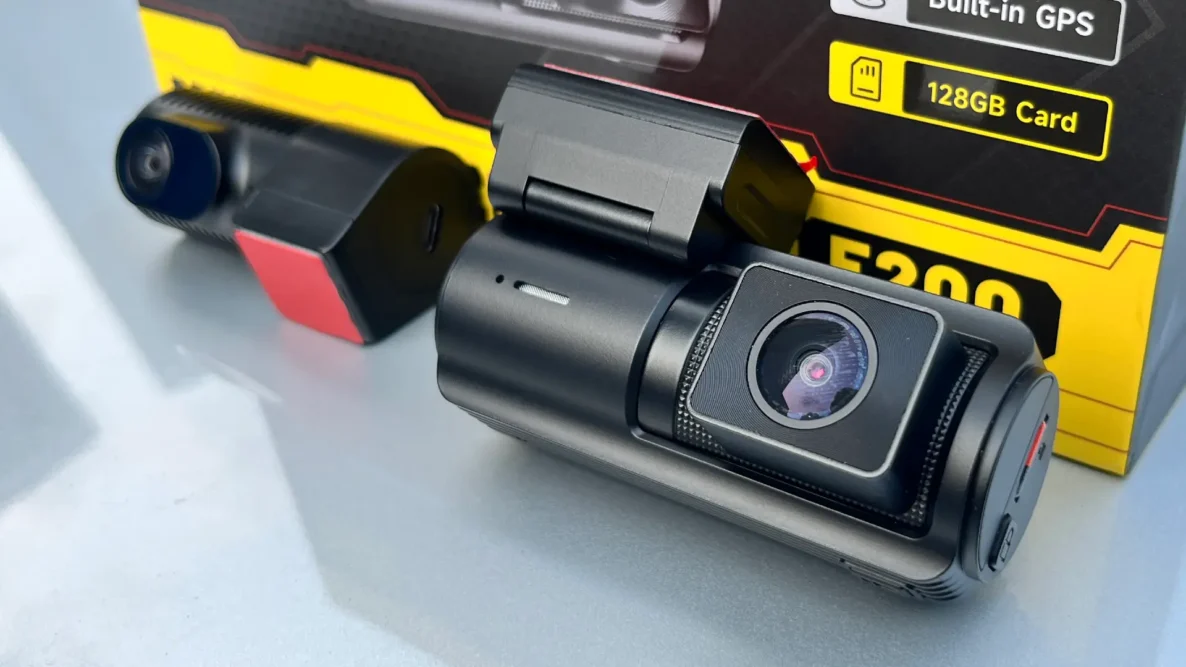
GKU makes plenty of noise about 4K recording, and whatever the exact technical breakdown between the two cameras, there’s plenty of resolution available.
The front camera uses Sony STARVIS 2 sensor technology, while the system also includes GPS, Wi-Fi6 with both 5.8GHz and 2.4GHz bands, impact detection, voice commands and an optional parking-monitoring mode if you add GKU’s separate hardwire kit.
There’s even a 128GB memory card included.
For £100-ish, that’s a lot of dashcam.
Installing the GKU E200
Cheap electronic gadgets tend to fall into one of two camps: surprisingly straightforward or an evening spent wondering whether throwing something through a window technically counts as returning it.
Thankfully, the GKU is in the first camp.
The cameras are compact, mounting them doesn’t require an engineering degree and GKU even supplies a little plastic trim tool for tucking the cables away behind the interior panels.

The rear-camera cable is inevitably the tedious bit because you have to get it from one end of the car to the other, but that’s hardly a GKU-specific complaint.
If you want to use the E200’s parking-monitoring functions, a hardwire kit is available separately for around £20. That gives the camera a permanent power supply rather than relying on the car’s accessory socket.
There are a couple of limitations worth knowing about before firmly attaching everything. Camera adjustment is primarily up and down rather than sideways, so positioning matters, while the rear camera isn’t designed to be routinely removed once fitted.
Do a trial run before committing the sticky pads to glass.
Is the GKU E200 dashcam actually any good?
Pleasingly, yes. The front footage is crisp and detailed, and the Sony sensor earns its keep when lighting conditions become more difficult.
Number plates are readable in situations where they need to be, the image doesn’t immediately disintegrate as daylight disappears, and the overall footage looks considerably better than we’d expect from such an inexpensive dual-camera package.
The rear image isn’t quite as impressive, but it’s still entirely adequate for the reason you bought a dashcam in the first place: establishing what happened when somebody drives into you and subsequently develops a radically different recollection of events.
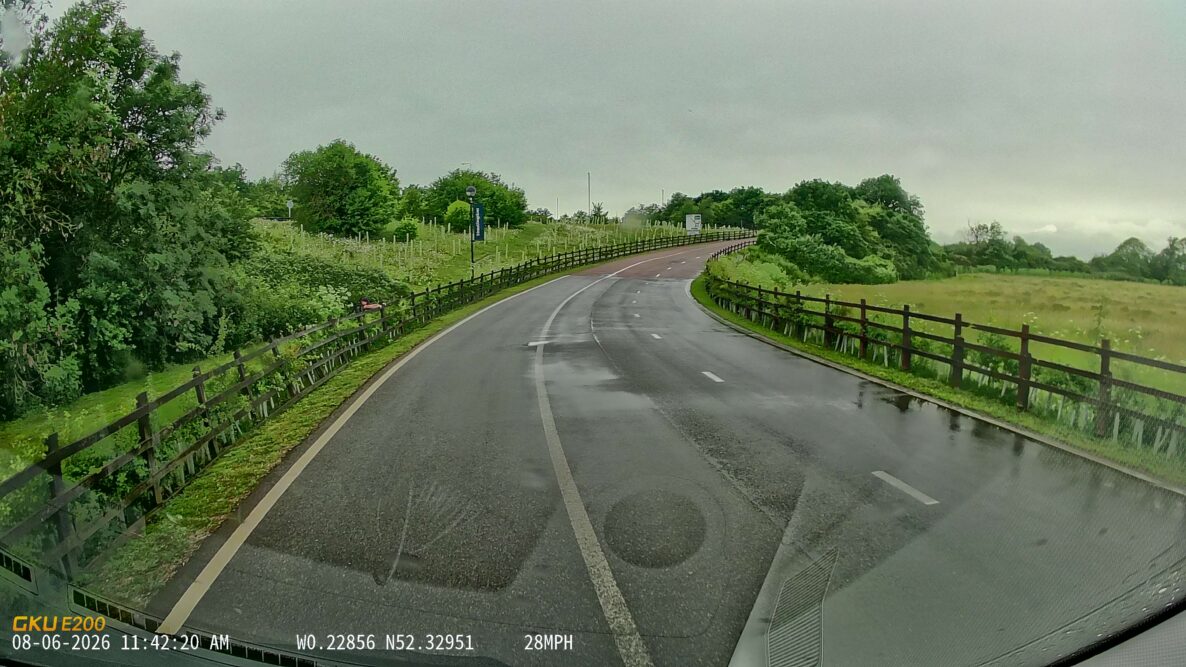
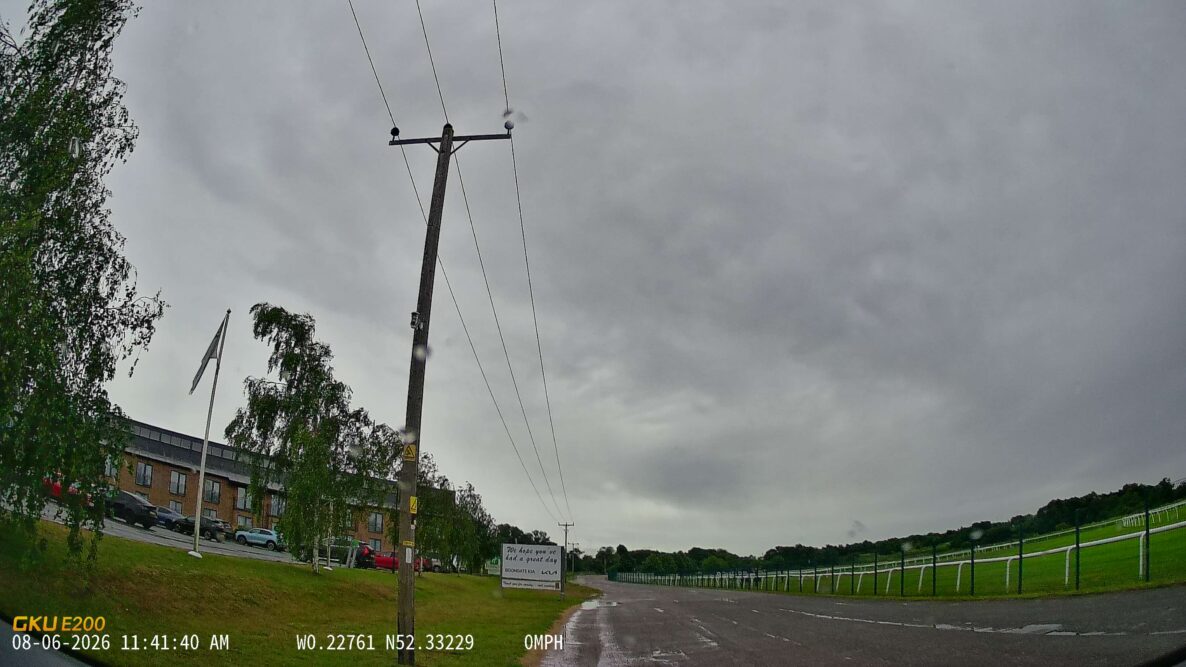
Spend £250 or £300 and you can absolutely get better footage. You can also get cameras with more sophisticated image processing and superior low-light performance.
But that’s rather missing the point: The E200 costs about £100.
At that price, the fact we’re comparing its footage with considerably more expensive cameras rather than apologising for it is impressive enough.
The features aren’t just there for the Amazon listing
Another pleasant surprise is that the secondary features actually work.
Built-in GPS records journey information, the G-sensor can automatically protect footage when it detects a significant impact, and there are nine voice commands covering functions including taking a photograph, locking a video, muting audio and switching the screen between camera views.
Voice control on a cheap dashcam sounds like precisely the sort of feature that would work perfectly in the lab before interpreting “take photo” as “turn off everything” somewhere outside Peterborough.
Instead, it works rather well.
There’s also parking monitoring available through an optional hardwire kit. We haven’t used it enough to feel as confident in it as the normal recording functions, so we’d see it as an extra feature rather than a main reason to buy the camera.
The GKU GO app
And now we reach the less polished part.
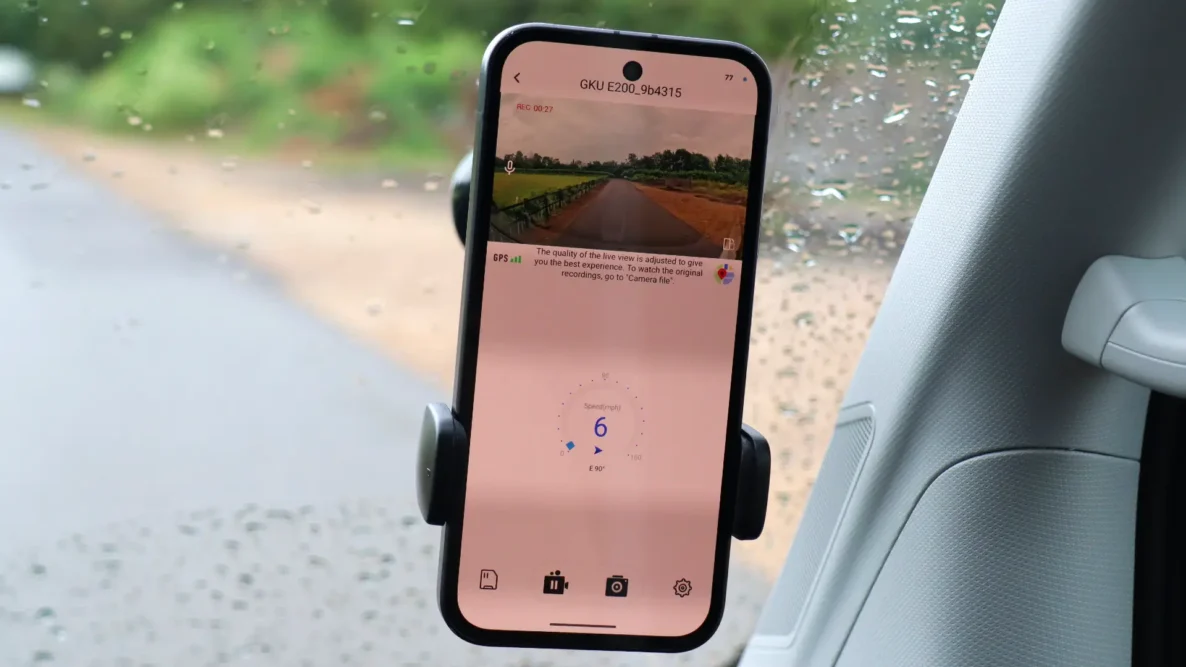
The GKU GO smartphone app works. Pairing with the camera is quick, and the camera uses Wi-Fi 6 so transfers are impressively quick, making downloading clips to your phone is relatively painless. You can even stream live images to the app.
That’s about as much praise as we’re willing to heap upon it.
Compared with the apps supplied by established dashcam manufacturers such as Nextbase, Viofo and 70mai, GKU GO feels primitive. The interface lacks polish, and there’s little sense that anyone has spent an afternoon worrying about the finer points of user experience.
But ugly and functional is forgivable on a £100 dashcam.
Something else bothered us rather more.
Then we read the privacy policy
GKU GO asks you to agree to a lengthy privacy policy when setting up the app.
It’s quite something.
There are the obvious signs that this isn’t a document written specifically with British E200 buyers in mind. It discusses sharing content to WeChat and microblogging services, and its rules on prohibited community content include references to state secrets, undermining national unity, state religious policies and, wonderfully, “feudal superstition”.
The policy also says GKU may collect information including your device model, device ID, IP address, time and place of use and other usage information.
Its community section says photographs, videos and driving tracks uploaded there are public by default. If GPS information is included, your location can also appear, while the policy allows certain shared information to be forwarded to third-party platforms.
GKU also reserves broad rights to use aggregated anonymous statistical data.
None of this proves that the E200 is secretly uploading every journey you make to a server in Shenzhen, and we haven’t found evidence that it is.
The most alarming wording particularly concerns optional community and sharing features, rather than simply recording footage to the memory card.
Nevertheless, privacy documentation is supposed to make you more confident about what happens to your data, and this achieves roughly the opposite.
For a device recording where you drive, when you drive there and potentially what happens around you while you’re doing it, we’d expect far more transparent explanations of what information leaves the phone, why it’s needed and what happens to it afterwards.
We’d avoid the community features entirely, decline permissions that aren’t essential, and use the GKU GO app primarily as a way of communicating with the camera.
GKU E200 dashcam: The Average Joes verdict
And that’s frustrating, because the actual GKU E200 is excellent value.
It isn’t merely good for a cheap dashcam. The camera is compact, installation is painless, useful features such as GPS and voice control work properly and, most importantly, the recorded footage is genuinely impressive.
We went into this expecting the specification sheet to be doing considerably more work than the hardware, and it isn’t.
There’s no escaping that spending three times as much will buy you a more sophisticated product, and established brands generally provide considerably more polished apps. We’d also like GKU to be rather clearer about exactly what it means by its 4K+4K marketing.
But if all we were judging were the camera, the E200 would be remarkably easy to recommend.
Unfortunately, a connected dashcam isn’t just a camera anymore.
GKU needs to put the same effort into its software, localisation and privacy documentation that it has apparently put into making the hardware.
The GKU E200 is one of the best cheap dashcams we’ve tried. We’d just rather its privacy policy didn’t make us want to disconnect it from the internet.
Product tested: GKU E200 4K Dual Dash Cam
Price: £95
Average Joes rating: ★★★★☆

He is the founder of Huff Media, publisher of Professional Pickup, Professional Van, Average Janes, Average Joes, and CALIBRE. His work focuses primarily on light commercial vehicles, pickups, and real-world vehicle use, with much of his time spent on manufacturer launches, industry events, and long-term vehicle testing.
- GKU E200 review: A brilliant £100 dashcam with one rather awkward problem - 28 August 2026
- Check under your bonnet with a free prostate test from Subaru - 27 August 2026
- Digger-engined JCB Hydromax smashes 400mph land speed record - 24 August 2026