

Getting our retro vibe on, we thought it was time to dig through the back of the cupboard and revisit some of the classic computer games we grew up with. These aren’t meant to be the obvious, all-time greats, but the titles that stuck with us, the ones we spent far too many hours playing through the 1980s and 1990s.
After Burner (1987)
Taking control of an F-14 Tomcat jet is every boy’s dream, and we were no different. Using your missiles or cannons to destroy your enemies, the chase-view perspective and dramatic barrel rolls gave the game a sense of speed lacking in its rivals.
Originally only in arcades, After Burner was so successful that the game and its sequel were ported to seemingly every platform, including the Sega Master System and Mega Drive, the Commodore 64 and Amiga, the Atari ST, and the Amstrad CPC, amongst others.

Dizzy (1987)
Designed by two Brits, Dizzy was a true classic. Its classic platform game elements made it a popular title, spawning 15 versions between 1987 and 1992.
We’ve picked Dizzy’s second adventure, Treasure Island Dizzy, as our favourite. You control the anthropomorphic egg as you explore, trade and bargain as you work to solve puzzles and escape the island.
The first game in the series was released for the Amstrad CPC, ZX Spectrum, and Commodore 64 in 1987, but the series spread across almost every platform over the next five years, including the Atari ST and Commodore Amiga, Nintendo and Sega consoles, and even the handheld Sega Game Gear.

International Karate + (1987)
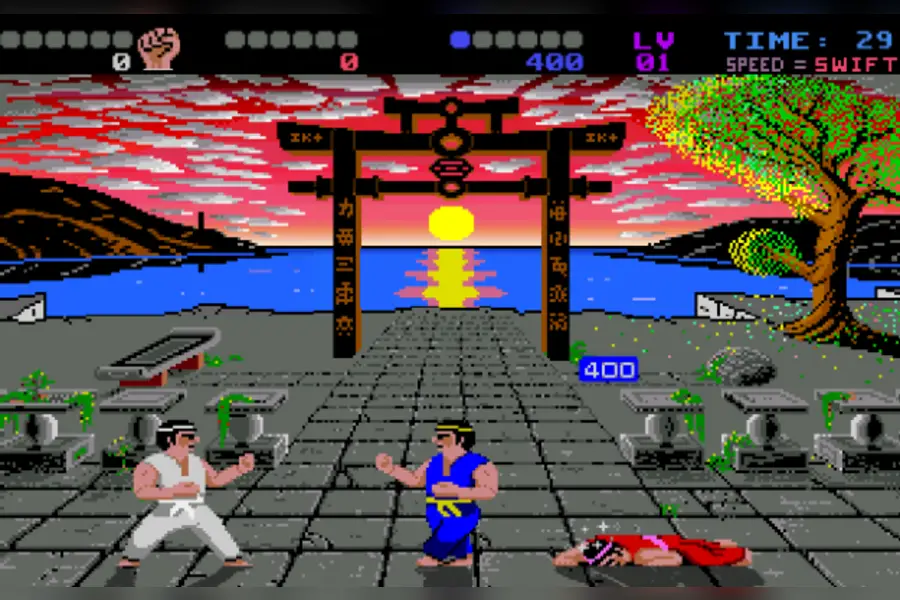
Originally appearing on the ZX Spectrum and Commodore 64, IK+, as it was widely known, is the first computer game I have memories of. Hours waiting for the cassette to load for three players to be on screen (with one or two of them controlled by the computer), fighting to the death! Each successful fighting move earned points, and the first to score six points was declared the winner.
There are sub-games involving bouncing balls and kicking bombs, and, on some versions, easter eggs hidden in the background — Pac-Man passing by, submarine periscopes appearing, and even spiders dropping down.
Following its initial release, IK+ made it to the Commodore Amiga, Atari ST and Amstrad CPC the following year. Future release came on the Amiga CD32 and Sony PlayStation, but stayed faithful to the original.
Golden Axe (1989)
Released in 1989 on the Sega Master System and Mega Drive, Golden Axe became an instant hit all around the world. You take control of one of the three characters: axe-wielding dwarf, Gilius Thunderhead; man mountain, Ax Battler; and the blonde Amazonian Tyris Flare, and fight against Death Adder’s army of henchmen, skeleton warriors, and knights.
You can attack using your standard weapon or cast a spell on all enemies. After defeating the end boss, Death Adder, a higher-level enemy then confronts you, the aptly named Death Bringer, which you must defeat to complete the game.
Following its initial release, Sega ported the game to virtually every system, including the Amiga and ST, ZX Spectrum, Amstrad CPC, Commodore 64, and Bandai’s WonderSwan Color. Yes, that really exists.

Streets of Rage (1991)
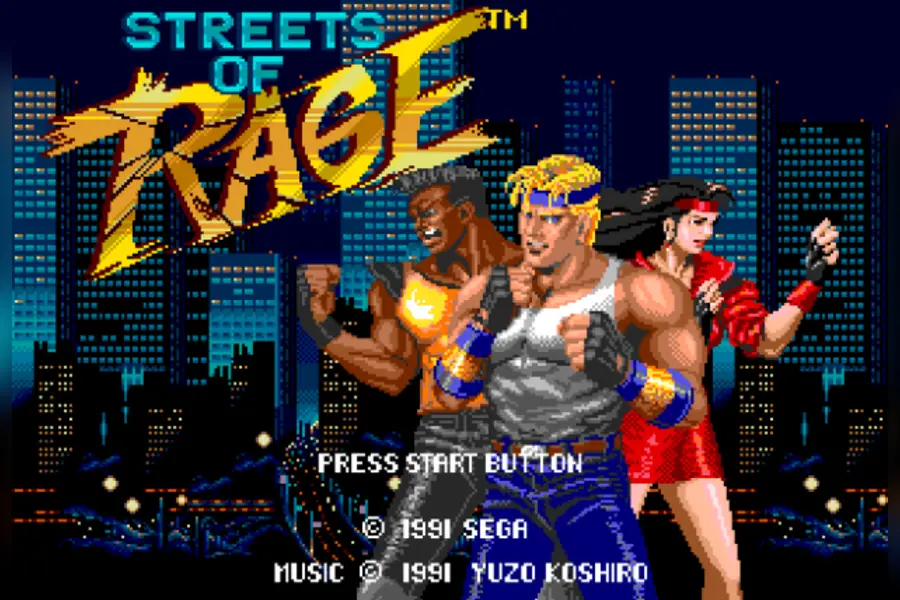
The side-scrolling beat ’em up was an instant hit on the Sega Mega Drive before making its way to the Master System and the portable Game Gear, remaining a Sega exclusive until it hit the Nintendo Wii in 2007. It was the first of three titles, the sequels being unimaginatively titled Golden Axe 2 and Golden Axe 3, but they were among the best in the genre.
Streets of Rage, Sega’s answer to Final Fight, follows the story of three young police officers (Adam Hunter, Axel Stone and Blaze Fielding) in a city controlled by a criminal syndicate led by a Mr X, where crime is rampant, which leads the three heroes to make a pact to leave the force and topple the syndicate by themselves.
Gameplay was straightforward and simple. Choose from three characters, Adam Hunter, Axel Stone and Blaze Fielding, punching and kicking their way through various locations which make up eight rounds, with the last round against the final boss — avoiding ‘death drops’ on the way. You can either play solo or two-player co-op, though on the final round, one player does have the option to turn against their friend and side with the big boss.
Paper Boy (1986)
A true classic if ever there was one, and proof that even the old Commodore 64 could (more or less) replicate the arcade experience.
The aim of the game? Take control of the paperboy and deliver papers to the selected houses. Bizarrely, you also had to cause significant damage to your non-customer’s property while avoiding obstacles ranging from cats and dogs to construction workers and tornadoes. Seven levels (representing seven days) got tougher each time, but get through all of them, and you could retire. Games were different back then.
After debuting on the Commodore 64, it hit every major computer, including early models like the BBC Micro, Electron, and Apple II.

GoldenEye 007 (1997)
I lost count of how many hundreds of hours friends and I wasted playing multiplayer GoldenEye on the Nintendo 64 and battling through the multiplayer levels of Temple, Complex, Caves, Library, Basement, and Stack with weapons such as the rocket launcher, pistols and, of course, the one-shot-kill Golden Gun.
As a 3D action game, it’s often hailed as the finest game of its kind. While not as expensive as current games, and with a linear path through the title, it still managed to feel huge, challenging, yet achievable.
Nintendo kept the game to themselves since its release, but updated it 13 years later for the Wii and DS, although neither version achieved the critical acclaim of the original.

Outrun (1987)
OutRun was one of the first popular racers that defined today’s games, such as Gran Turismo and Need for Speed. The game had you blasting your way through various roads and scenery in a drop-top Ferrari Testarossa (though no license was ever granted) with your girlfriend by your side — all while listening to what is still a fantastic soundtrack.
Trying to beat the clock and your personal best times, every checkpoint gave you more time and a choice of where to go next. The options were rudimentary, affecting little beyond the scenery and lighting, but they made the game feel more open than other racing games.
Starting life as an arcade game, it was ported to the Sega Master System in 1987, before spreading to the usual computer and console suspects, as well as the Hudson Soft TurboGrafx-16, PC Engine, and MSX-based computers.

Xenon 2: Megablast (1989)
The Bitmap Brothers created some of the greatest games seen in the 90s, and Xenon 2 was undoubtedly the finest shoot-em-up.
It’s a traditional vertically scrolling space shooter, which sees you flying along, battling against ever more challenging enemies and end-of-level bosses. But cash collected en route could allow you to buy increasingly more elaborate upgrades, leaving you with a visually stunning machine of death.
Level design was intense, with dead ends requiring back-flying, deadly organic walls, mechanical killing machines, and a depth that made it feel, if not quite real, then engaging and immersive. That was all backed by a thumping soundtrack from Bomb the Bass — a nod to the flimsy storyline that flows through the game.
Versions were created for the Atari and Amiga, with Sega Master System, Mega Drive and CDTV versions following. Its popularity endured well beyond its initial release, with a version making it to the Atari Jaguar console in 2016 — 20 years after production of the machine stopped.

We’re sure there are plenty of classics we’ve missed, and everyone’s favourites will differ. These are simply the games that stayed with us — remembered as much for the era they belong to as for the hours spent playing them.

- Krypton in your Kitchen: WIN Superman Official Cookbook prize bundle - 1 December 2025
- DreamToys 2025 reveals this year’s must-have Christmas gifts - 24 November 2025
- Driving the Aston Martin Lagonda, Britain’s most bonkers luxury car - 11 April 2025